Friday, October 25, 2013

What about workbooks?

I find it beautifully ironic that when R goes off to play by herself she often chooses to "play school."  Some mornings she asks me to play with her.  There have been many mornings (when I had other plans and intended to let her and C just play on their own) when I just couldn't say no to that little face telling me, "You're the teacher," as if this weren't something we do all day every day anyway!

That's the thing: I don't think she realizes that what we do IS school.  There are some days that are more formal than others when I think she is aware that we're "doing school."  But other days she'll make comments to me about how sometimes we forget to do school, and I just have to laugh because she doesn't think that what we are doing counts.  I think that's a great thing, because that means it's natural and fun.  That's my goal.

Sometimes I think she craves the structure more though, and I'm happy to comply.  On those days I instruct her to get dressed, pack her backpack, and then have her sit in her little chair at her little table. C sits with her because she has to do everything big sister does.  I sit up front.  We stand and say the pledge of allegiance, recite our ABC's, and maybe read a book.

Then we break out the workbooks.  We don't do them very regularly because a four-year-old only has a limited attention span.  But when we start a page, I require her to at least finish what she began.  (It is very important to me that she learn to be a finisher.)  This requires me to get creative sometimes, to make it exciting even once the novelty has worn off.

The other day, we did our math workbook with Cheerios.  When R finished a pair of problems, (3+4 and 4+3 for example,) I would give her the number of Cheerios that were the answer, (in this example, 7.)  That was the extent of my idea; I figured she'd eat them and then move on to the next problem.  Instead, she decided she wanted to show me all the different ways she could make that number, (0+7, 1+6, 2+5, etc.) using the Cheerios I had given her.


So, what do I think of workbooks?  They're good occasionally.  They're a great tool in our bag of options, but never over-do it!  I may make R finish any page she begins, but I definitely don't require her to finish any workbook she begins.  We have a whole shelf of different workbooks that I let her choose from depending on her mood and our purposes.  They are great for practicing already learned concepts, but I try not to use them to learn things for the first time.  Mainly this is because I want to take full advantage of all that homeschooling has to offer, and one of the greatest things homeschooling offers is the ability to let your kids learn hands on.  When we first began learning addition, it was always using real objects or people.  (If there are two parents and two kids, how many are there in our family?)  When we were learning about trees, we went outside and felt them, smelled them, looked at them.  We like to get our hands dirty!

But some days I don't really mind "playing school."  :)

Questions?

I was wondering if anyone has any particular questions they would like me to answer about homeschooling here on my blog?  Is there anything you'd like me to elaborate or focus on for a given post?  If not, then I'll just keep on talking about whatever comes to mind or interests me for the moment.

But please don't hesitate to comment below and pose any questions you might have!  I promise I'll do my best to answer them!  :)

Wednesday, October 23, 2013

Why do I homeschool my kids so young?

After writing yesterday's post about it being an "off-day," I felt the need to clarify something.  I realized that I could come off as a seriously neurotic and controlling or perfectionistic mother.  I have a four-year-old and a two-year-old.  I know I don't need to be doing homeschool yet.  And trust me, we have had plenty of truer "off-days" than the one I described yesterday.

We have had days (particularly sick days) when we haven't done a thing, days when we DID watch TV all day long and I didn't lift a finger to do any chores or encourage any learning at all.  For me, those same days turn out to be the days when I feel the most anxiety.  Those are the days that I am least patient and loving with my girls.  Those are the days that my children argue more and listen less.  And those are the days when I come away feeling absolutely awful about myself.  I try REALLY hard to avoid days like that, but less because I'm concerned about living out some idealistic life and more because I just can't stand the way I or our home feels at the end of it.

Again, for the sake of clarity, why do I homeschool my four-year-old instead of waiting until a more "normal" age?  Because my personality is such that if we weren't officially homeschooling, I would still be looking for intentional activities to do with the girls; things to keep us occupied and busy and make me feel productive; things that allowed us to work together and interact and draw closer in our relationships.  So, for me, it just makes sense to let those activities be school centered.  Why not, when I'm going to be putting forth all this effort anyway?

The key is that we don't keep pursuing any course that is adding stress or straining our relationship.  It requires a sort of nonchalance about what we do and when and how.  I keep general goals in mind and then use all my creative and persuasive powers to make it desirable and fun.  If I really badly want to read a chapter of The Secret Garden, but no matter what I say R isn't interested, I drop it.  If we are working on handwriting and I feel myself losing patience, I take a step back and change my approach, or else bag it altogether for the day.  There are no requirements here, no necessary bench-marks.  Everything we do is extra!

Tuesday, October 22, 2013

Why is homeschooling ideal in terms of flexibility?

Today was a quieter homeschool day for us.  In accordance with my goals we still did just a little bit of reading, a little bit of writing, and a little bit of math, (more math than anything else because that's what R seems to prefer right now.)  Other than that we mostly just played, went to the library, and had friends over.  It was a nice break, a needed "day off."

This is one of the things that I absolutely LOVE about homeschooling.  I love that it follows my schedule instead of all the pressure that can come with having to follow the school system's schedule.  I love the flexibility.  I love that when baby brother is born in a few months, I'll be able to take a full month off in the middle of winter without any guilt or negative consequences.  This is possible in part because R and C are still so young, but also because we do school six days a week year round.  We don't take regular breaks on weekends and over summers.  Why would we, when homeschool is almost as natural as breathing?

Even on days like today when I feel like I've taken a break, (mainly because there was far less intentional teaching done on my part,) we still had our gospel lesson over breakfast and multiple conversations about informative things in addition to our reading, writing, and math.  We talked about what cemeteries are, what gills are for, and how the sun helps plants to grow.   We also covered issues such as sharing, taking care of our bodies, and not watching too much TV.  And this was on an off day!  :D

I guess you could say that my "off days" are just days when we slip into more of an unschooling methodology for a bit.  The unschooling theory is essentially that life will naturally lead you to the things you need know.  Now, I don't subscribe to this method entirely, but it certainly has it's merits.  I believe in child-led learning to a point.  I believe that my girls will retain those things that they are interested and completely invested in better than those things that are forced upon them.  Accordingly, I try to take full advantage of their curiosity and passions.  But, in addition, I feel it absolutely necessary for some things to be introduced into their line-of-sight which will hopefully lead them to show interest in a greater variety and depth of topics.

Today was an unschooling day for us though, and it worked.  I feel like both R and C got the attention they needed along with plenty of intellectual stimulation.  Any day that we don't spend glued to screens for eight hours or more counts as a success in my book.  ;)

Monday, October 21, 2013

How do you make writing fun for young ones?

One of my longer term goals for this fall was to get R more comfortable with writing.  There's no great rush; I feel no need to drill her or get her handwriting to any certain level.  For me it's all about creating a regular habit of writing at least a little every day.  It's about familiarity and comfort in doing something she'll be doing for the rest of her life.

We've had a hard time with handwriting when I've tried it in the past though.  I think this was because I really just didn't know how to approach it.  I have a lot of handwriting paper with the colored solid and dotted lines, so I think I was a little overanxious about getting her to write all of her letters just so.  But whenever I attempted it with her, it turned into a bit of a battle.  She ended up bored, and I frustrated.  So I gave us a bit of a break this last week.

In planning for this week, I decided to revisit writing and this time I brainstormed a little about ways to make it fun.  (I actually have to keep reminding myself that I have four-year-old and not to expect so much!)  So here were the ideas I came up with, two of which we tried with great success today:

  • Make a treasure hunt for Daddy using sticky notes
  • Write back and forth to each other instead of talking for fifteen minutes
  • Copy words or sentences from books or movies around the house
  • Start a Christmas wish list
  • Write notes or letters to friends or family members
  • Create labels for items around the house
  • Make a menu for dinner

I'm sure I could think of more if I took the time; this was just my quick brainstorm list.  The point is that before I can do anything effectively with the girls, they have to really want to do it.  I'm left with the option to either follow their fancies, or inspire them to fancy my goals.  ;)

Friday, October 18, 2013

How do you inspire your child to read the classics?

I have begun to read The Secret Garden aloud to the girls this week.  I have read a few longer books to them before: The Wind in the Willows, Little House in the Big Woods, The Lion the Witch and the Wardrobe, etc.  I feel like this has been good for them on multiple levels.  They learn patience for a long drawn-out story versus the short quick ones they get in picture books.  They gain valuable moral lessons from higher quality literature.  They get exposure to a wider vocabulary.  And probably most important to me right now, they get in the habit of being read to every day.

I don't require their full-attention; I don't expect them to sit still or look at the words with me.  But I do expect them (especially R) to listen.

I make it fun and engaging. I stop and talk a lot, asking questions and making sure R is following the story line or drawing out the most important lessons.

When we last read, we got to the part of the book where (if you're familiar with the story) Martha's mother, a very poor mother of twelve children, out of the sweet goodness of her heart buys Mary a jump-rope with the little money she has.  She doesn't personally know Mary.  Martha is Mary's friend but also her maid, and Mary is the remarkably wealthy and spoiled child who lives with her uncle in a mansion.  But she is orphaned and lonely, and Martha's mother feels compassion for her and her situation.

I was so touched by this part of the story.  Granted, it is just a story.  But the truth is that there are people out there like this, who sacrifice every day for others even though they themselves are in need. What a great lesson in Christlike love.

Did R fully grasp it?  I don't know. Probably not.  But maybe, just maybe, our reading classic books together every day will cultivate a desire within her to read classic books on her own someday which will unlock the door to a wealth of equally wonderful moral lessons to be learned.

Thursday, October 17, 2013

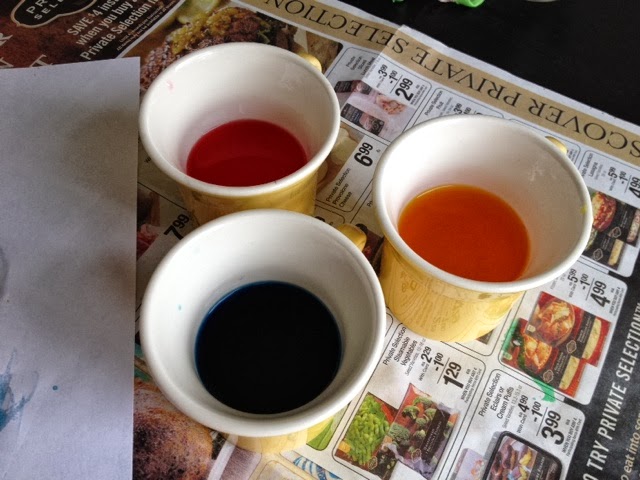
Mixing Colors Experiment

R is fascinated with mixing colors lately for some reason.  We've done lots of online games to learn about which colors mix to make other colors, but the other day I finally pulled out the big guns and did some real-life hands-on learning.  We just filled some mugs with water, put a bunch of drops of food coloring into each and then used a dropper to experiment away. She loved it.  :)